Mathematics tutoring services are provided free through the following areas:
- Math Learning Center (Ammerman Campus, Huntington Library 104)
- Math and Science Learning Center (Eastern Campus, Montaukett Learning Resource Center 222)
- Academic Tutoring Center (Michael J. Grant Campus, Learning Resource Center 149)
- Students can use any of the tutoring services regardless of the campus they take their coursework.
Students are initially placed into mathematics courses based on their mathematics background. Students who have not studied mathematics within the past two years should discuss their competency with the counseling center or department of mathematics. Students who place into MAT001 must also complete MAT007 or MAT009 after passing MAT001 to complete the developmental sequence. Students placing into MAT006 are strongly encouraged to take the one semester (5 credit) course. However, students can meet the requirement by taking MAT001 followed by MAT007 or MAT009. Following the completion of MAT006, MAT007 or MAT009, refer to the “Guide to Mathematics Course Selection” and course descriptions listed below.
Guide to Mathematics Course Selection
The following diagram is presented to assist students in selecting mathematics courses based on their mathematics placement.
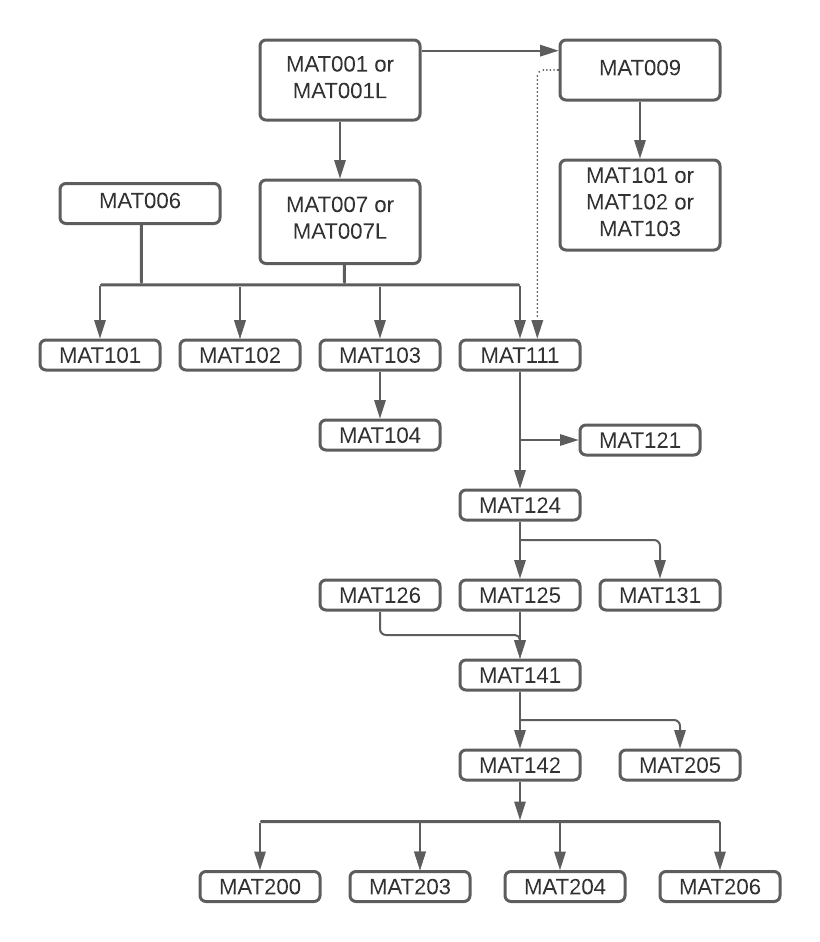
MAT001 - Developmental Mathematics Skills
Course Description:
For the student who needs to learn or strengthen basic arithmetic skills, introductory plane geometry concepts, and to prepare for entry into beginning algebra. Grading in this course determined by mastery of completed topics. Graded on an S-R-U-W basis. Does not fulfill requirements for any degree or certificate. Students taking this course must also take MAT007 or MAT009 before enrolling in a college-level mathematics course. No prerequisite. Offered on: A-E-G / 3 cr. hrs.
Learning Outcomes:
Upon completion of this course, students will be able to:
- Perform the four arithmetic operations, addition, subtraction, multiplication, and division with the following sets of numbers: whole numbers, decimals, fractions, mixed numbers, and signed numbers.
- Read and write whole numbers and decimals using correct place values; round off whole numbers and decimals to specified place value.
- Correctly evaluate arithmetic expressions with the following sets of numbers: whole numbers, decimals, fractions, and signed numbers.
- Be able to write equivalent forms of a fraction, mixed number, decimal, and percent.
- Compare the size of decimals, whole numbers, fractions, and signed numbers using the number line and inequality signs.
- Demonstrate an understanding of ratio and proportion and be able to solve a proportion.
- Acquire a clear understanding of the concepts of perimeter, area, and volume when applied to simple geometric figures.
- Evaluate expressions with variables using signed numbers.
- Develop the ability to analyze appropriate verbal problems.
MAT001L - Developmental Mathematics Skills Laboratory
Course Description:
Provides an opportunity to receive recognition for MAT001 and/or MAT007 in computer-enhanced non-traditional setting. Through a combination of computer-based lessons, collaborative learning and group instruction, students progress at their own pace to learn required materials for the course in which they are enrolled. Students beginning with MAT001L can seamlessly move into MAT007L and receive recognition for highest course completed during the semester. If objectives of course are not completed within the semester, students may register for MAT001L/MAT007L the following semester and continue from the level previously reached. MAT001L does not fulfill requirements for any degree or certificate. No prerequisite. Offered on: A-E-G / 4 cr. hrs.
Learning Outcomes:
Upon completion of this course, students will be able to:
- Perform the four arithmetic operations, addition, subtraction, multiplication, and division with the following sets of numbers: whole numbers, decimals, fractions, mixed numbers, and signed numbers.
- Read and write whole numbers and decimals using correct place values; round off whole numbers and decimals to specified place value.
- Correctly evaluate arithmetic expressions with the following sets of numbers: whole numbers, decimals, fractions, and signed numbers.
- Be able to write equivalent forms of a fraction, mixed number, decimal, and percent.
- Compare the size of decimals, whole numbers, fractions, and signed numbers using the number line and inequality signs.
- Demonstrate an understanding of ratio and proportion and be able to solve a proportion.
- Acquire a clear understanding of the concepts of perimeter, area, and volume when applied to simple geometric figures.
- Evaluate expressions with variables using signed numbers.
- Develop the ability to analyze appropriate verbal problems.
MAT006 - Pre-Algebra and Algebra I
Course Description:
Review of arithmetic skills and introduction to the basic concepts of algebra. Topics include arithmetic skills, geometry, language of algebra, order of operations, signed numbers, linear equations, two equations in two unknowns, polynomials, solving quadratic equations by factoring, and selected verbal problems. Graded on an SA-SB-SC-R-U-W basis. Does not fulfill requirements for any degree or certificate. Serves as a prerequisite for any course for which MAT007 is a prerequisite. Prerequisite: Placement. Offered on: A-E-G / 5 cr. hrs.
Learning Outcomes:
Upon completion of this course, students will be able to:
- Perform the four arithmetic operations, addition, subtraction, multiplication, and division with the following sets of numbers: whole numbers, fractions, decimals, and signed numbers;
- Correctly evaluate expressions with the following sets of numbers: whole numbers, fractions, decimals, and signed numbers;
- Be able to write equivalent forms of a fraction, mixed number, decimal, and percent;
- Know the meaning of ratio and proportion and be able to solve a proportion;
- Acquire a clear understanding of the concepts of perimeter, area, and volume when applied to simple geometric figures;
- Understand the use of variables of real numbers and the use of order of operations;
- Understand the field properties of real numbers (associative, commutative, identities, inverses, and distributive properties) and be able to apply these properties in manipulating algebraic expressions;
- Solve linear equations and inequalities in one variable and develop the ability to analyze verbal problems and solve them;
- Perform polynomial addition, subtraction, multiplication, division, and factoring; solve polynomial equations that can be factored and apply these techniques to verbal problems;
- Simplify and perform basic operations on rational expressions; solve rational equations using factoring techniques;
- Understand radicals and simplify expressions involving radicals;
- Graph lines using: table of values, intercepts, slope.
MAT007 - Algebra I
Course Description:
Introduction to basic concepts of algebra. Equivalent to first-year high school algebra. Topics include language of algebra, order of operations, signed numbers, linear equations, simultaneous equations, factoring, solving quadratic equations by factoring, application of algebra to selected verbal problems. Graded on an SA-SB-SC-R-U-W basis. Does not fulfill requirements for any degree or certificate. Prerequisite: MAT001 or placement. Offered on: A-E-G / 4 cr. hrs.
Learning Outcomes:
Upon completion of this course, students will be able to:
- Demonstrate an understanding of the use of variables as representatives of real numbers, the use of the order of operations to evaluate algebraic expressions, and the meaning of terms, expressions, and factors.
- Demonstrate an understanding of the arithmetic properties of real numbers (associative, commutative, identities, inverses, and distributive properties) and be able to apply these properties in manipulating algebraic equations.
- Solve linear equations and inequalities in one variable and apply these techniques to simple models.
- Solve systems of linear equations in two variables using the techniques of graphing lines, algebraic substitution method, and the algebraic elimination method, and apply these techniques to simple models; moreover, the methods of graphing a line should be done using table of values, intercepts, and incorporating the slope of the line.
- Perform polynomial addition, subtraction, multiplication, division by a monomial, and factoring; polynomial equations that can be factored, should be solved and these techniques applied to simple models.
- Simplify and perform basic operations on rational expressions; moreover, be able to solve rational equations using factoring techniques and apply these techniques to simple models.
- Demonstrate an understanding of radicals and simplify expressions involving radicals.
MAT007L - Algebra I Laboratory
Course Description:
Provides an opportunity to receive recognition for MAT007 in computer-enhanced non-traditional setting. Through a combination of computer-based lessons, collaborative learning and group instruction, students progress at their own pace to learn required materials for the course in which they are enrolled. If objectives of course are not completed within the semester, students may register again the following semester and continue from the level previously reached. MAT007L does not fulfill requirements for any degree or certificate. Prerequisite: MAT001 or placement. Offered on: A-E-G / 4 cr. hrs.
Learning Outcomes:
Upon completion of this course, students will be able to:
- Demonstrate an understanding of the use of variables as representatives of real numbers, the use of the order of operations to evaluate algebraic expressions, and the meaning of terms, expressions, and factors.
- Demonstrate an understanding of the arithmetic properties of real numbers (associative, commutative, identities, inverses, and distributive properties) and be able to apply these properties in manipulating algebraic equations.
- Solve linear equations and inequalities in one variable and apply these techniques to simple models.
- Solve systems of linear equations in two variables using the techniques of graphing lines, algebraic substitution method, and the algebraic elimination method, and apply these techniques to simple models; moreover, the methods of graphing a line should be done using table of values, intercepts, and incorporating the slope of the line.
- Perform polynomial addition, subtraction, multiplication, division by a monomial, and factoring; polynomial equations that can be factored, should be solved and these techniques applied to simple models.
- Simplify and perform basic operations on rational expressions; moreover, be able to solve rational equations using factoring techniques and apply these techniques to simple models.
- Demonstrate an understanding of radicals and simplify expressions involving radicals.
MAT009 - Mathematical Literacy
Course Description:
This course integrates fluency with numbers, proportional reasoning, data interpretation, probability, algebraic reasoning, graphing lines, modeling, and communicating quantitative information. Mathematical concepts are investigated through problem-solving and discussions in the context of real-life topics such as, personal finances, population growth and density, government, economics, and health related statistics. This course prepares students to take a college-level non-algebraic course in mathematics, such as MAT101, MAT102, or MAT103. Students placing at this level and needing MAT111 should take MAT006 or MAT007 instead of this course. Graded on an SA-SB-SC-R-U-W basis. Does not fulfill requirements for any degree or certificate. Prerequisite: MAT001 or placement, and RDG098. Offered on: A-E-G / 4 cr. hrs.
Learning Outcomes:
Upon completion of this course, students will be able to:
- Apply the concepts of numeracy to investigate and describe quantitative relationships and solve problems in a variety of contexts.
- Represent proportional relationships and solve problems that require an understanding of ratios, rates, proportions, scaling, measures of central tendency, and data analysis.
- Reason using the language and structure of algebra to investigate, represent, and solve problems.
- Represent relationships between quantities in multiple ways (tables, equations, graphs) and solve problems that require an understanding of modeling.
- Communicate quantitative information in writing.
MAT101 - A Survey of Mathematical Reasoning
Course Description:
Liberal arts mathematics course which provides insight into nature of mathematical reasoning by examining basic structures such as logic, sets, real numbers, numeration systems and inductive reasoning. Notes: (1) Credit given for MAT101 or MAT107, but not both. (2) Fulfills SUNY-GE Mathematics. Prerequisite: MAT006, MAT007, MAT009 or equivalent. Offered on: A-E-G / 3 cr. hrs.
Learning Outcomes:
Upon completion of this course, students will be able to:
- Distinguish between deductive and inductive reasoning and be able to apply each in problem solving.
- Make connections between mathematical discoveries and the history of human thought.
- Perform the basic operations of set theory including: intersection, union and complement.
- Analyze basic data-type questions (survey results) using subsets and Venn diagrams.
- Translate verbal statements into symbolic forms of implication, conjunction, disjunction and biconditional.
- Test for the validity of arguments using various methods, indirect as well as direct.
- Define logical connectives using truth tables and be able to discover tautologies and prove theorems using truth tables.
- Convert to any base using expanded numeral concept as well as the division algorithm. Depending on the instructor's choice of optional topics, students should also be able to:
- Distinguish between rational and irrational numbers using the infinite decimal concept;
- Solve problems on a calculator or computer involving loans, interest, mortgages, annuities and life insurance;
- Analyze switching circuits using logical equivalences;
- Write programs in basic which utilize a loop, using proper structured programming techniques;
- Diagram the logical design of a computer or calculator.
MAT102 - A Survey of Contemporary Mathematical Topics
Course Description:
Liberal arts mathematics course providing an appreciation of contemporary mathematics by examining nontraditional topics such as probability and statistics; theories of games, groups and numbers; and finite differences. Note: Fulfills SUNY-GE Mathematics. Prerequisite: MAT006, MAT007, MAT009 or equivalent. Offered on: A-E-G / 3 cr. hrs.
Learning Outcomes:
Upon completion of this course, students will be able to:
- Demonstrate an understanding of the use of factorials, combinations and permutations;
- Demonstrate an understanding of what is meant by probability and conditional probability;
- Compute P(A), P(A, given B), P(A and B) and P(A or B);
- Demonstrate a fundamental knowledge of axiomatic structures by comparing different geometric systems;
- Demonstrate a fundamental knowledge of number theory (congruence classes, prime numbers, perfect numbers, divisibility and sequences).
- Solve two-dimensional linear programming problems graphically;
- Demonstrate a fundamental knowledge of statistics (frequency distributions and their graphs, averages and variability);
- Demonstrate a fundamental knowledge of matrices, their operations and uses;
- Demonstrate a fundamental knowledge of game theory, mathematical expectation and how to solve 2x2 games;
- Demonstrate a fundamental knowledge of finite groups and their applications;
- Find the general term of a mathematical sequence using finite differences or other methods;
- Use mathematical induction to prove series formulas.
MAT103 - Statistics I
Course Description:
For students interested in social sciences, health sciences, business and industry. Theory of probability is used to develop methods of statistical inference, confidence intervals and decision theory. Topics include sample spaces, statistical models, binomial and normal distribution, t-distribution and chi-square distribution. Note: Fulfills SUNY-GE Mathematics. Prerequisite: MAT006, MAT007, MAT009 or equivalent. Offered on: A-E-G / 3 cr. hrs.
Learning Outcomes:
Upon completion of this course, students will be able to:
- Demonstrate an understanding of basic statistical terms;
- Organize and describe data, mathematically and pictorially;
- Understand and compute measures of central tendency and variability;
- Apply basic probability principles;
- Write and do basic analysis using binomial, normal, t, and chi square distributions;
- Understand and apply the central limit theorem;
- Understand, conduct and interpret hypothesis tests;
- Understand, construct and interpret confidence intervals.
MAT104 - Statistics II
Course Description:
For students interested in social sciences, health sciences, business and industry. Expands on statistical concepts and methods treated in MAT103 and provides opportunity to apply statistical methods to an actual survey. Teaches how to select a sample, interview respondents and analyze data. Additional topics include non-parametric statistics, correlation and regression, analysis of variance and decision making. Prerequisite: C or better in MAT103. Offered on: A-E-G / 3 cr. hrs.
Learning Outcomes:
Upon completion of this course, students will be able to:
- Understand the significance of variation between samples as epitomized in the Central Limit Theorem;
- Understand that statistical results involve degrees of uncertainty;
- Demonstrate familiarity with the notion of design of experiments in the context of devising statistical studies involving the formulation of questions, the selection of random samples and the collection of sample data;
- Conduct, either individually or as part of a group, a series of complete statistical studies, to analyze fully the data and to come to appropriate statistical conclusions based on the data. These studies should include some or all of the following:
- Constructing confidence intervals to estimate population parameters such as the mean and the proportion based on random samples drawn from some population;
- Testing a statistical hypothesis about a population mean, a population proportion, a difference of means and a difference of proportions based on random samples drawn from some populations;
- Performing a regression/correlation analysis for a set of paired data;
- Performing a chi-square analysis for a contingency table;
- Performing a goodness-of-fit test;
- Performing an analysis of variance test;
- Applying a variety of non-parametric statistical tests; including the sign test, the rank-sum test, the runs test, and the use of the Spearman rank correlation coefficient;
- Communicate by preparing formal written or oral reports on the results of statistical studies;
- Understand that DATA = FIT + RESIDUAL;
- Distinguish between different types of samples; i.e., random, cluster, quota samples.
MAT106 - Mathematics for Health Science
Course Description:
For students pursuing nursing, veterinary science technology and other health sciences degrees. Includes review of basic concepts such as proportions, exponents, and Cartesian coordinate system. Topics include scientific notation, dosage calculation, metrics, dimensional analysis, logarithms and logarithmic scales, vectors, basic statistical terms, simple biostatistics. Prerequisite: MAT006, MAT007, MAT009 or equivalent. Offered on: G / 3 cr. hrs.
Learning Outcomes:
Upon completion of this course, students will be able to:
- Calculate required dosage for problems involving dosage, weight and time.
- Convert between different clinical units of measurement.
- Perform dimensional analysis involving three or more units.
- Interpret basic graphs, including those with logarithmic scales.
- Calculate basic statistics (such as means, median, standard deviation).
- Interpret statistical information (such as correlation coefficient, P-values).
- Convert between scientific notation and floating point notation.
- Do problems involving simple vector arithmetic.
MAT107 - Computer Mathematics Concepts
Course Description:
For students pursuing a Computer Technology degree program. Stresses problem-solving and computer mathematics concepts. Taught with a computer lab component. Topics include number systems, computer arithmetic, sets, logic, functions, vectors, matrices, sequence, selection and repetition, and problem solving. Note: Credit given for MAT107 or MAT101, but not both. Prerequisite: MAT006, MAT007, MAT009 or equivalent. Offered on: A-E-G / 4 cr. hrs.
Learning Outcomes:
Upon completion of this course, students will be able to:
- Perform the basic operations of set theory including intersection, union, and complement;
- Understand binary number system, conversion to decimal and hexadecimal systems;
- Distinguish between integer/real number representations in computer;
- Translate verbal statements into symbolic forms of conjunction, disjunction, and negation;
- Perform matrix manipulations, including addition and subtraction;
- Convert word problem specifications into algorithms that can be used to develop computer solutions.
MAT111 - Algebra II
Course Description:
Continuation of study of basic concepts of algebra. Topics include brief review of elementary algebra, solutions of second-degree equations, radicals, complex numbers, rational expressions, polynomial expressions, rational exponents and roots, systems of equations and inequalities. Note: Fulfills SUNY-GE Mathematics. Prerequisite: MAT006 or MAT007 or equivalent. Offered on: A-E-G / 4 cr. hrs.
Learning Outcomes:
Upon completion of this course, students will be able to:
- Solve the following types of equations: linear equations, quadratic equations, absolute-value equations, equations involving rational expressions, equations involving radicals, systems of two equations in two unknowns, systems of three equations in three unknowns.
- Solve the following types of inequalities: linear inequalities, absolute-value inequalities, systems of linear inequalities in two variables.
- Graph the following: lines, parabolas, linear inequalities in two variables.
- Perform the elementary operations on the following: polynomials, rational expressions, complex numbers, radicals.
- Simplify algebraic expressions including: reducing to lowest terms; complex fractions; algebraically rewriting results using basic definitions, laws of exponents, distributive law, factoring, and other basic properties of real numbers; rationalizing the denominator.
- Set up and solve word problems which apply linear equations, quadratic equations, equations involving rational expressions.
- Interpret the basic relationships linking linear equations and linear inequalities in two variables, and parabolic equations to their graphs such as: solution sets, slope, parallel and perpendicular lines, forms of equations of lines, x-intercepts, y-intercepts, intersection of lines.
MAT111L - Algebra II Laboratory
Course Description:
Continuation of study of basic concepts of algebra. Topics include brief review of elementary algebra, solutions of second-degree equations, radicals, complex numbers, rational expressions, polynomial expressions, rational exponents and roots, systems of equations and inequalities. Note: Fulfills SUNY-GE Mathematics. Prerequisite: MAT006 or MAT007 or equivalent. Offered on: A-E-G / 4 cr. hrs.
Learning Outcomes:
Upon completion of this course, students will be able to:
- Solve the following types of equations: linear equations, quadratic equations, absolute-value equations, equations involving rational expressions, equations involving radicals, systems of two equations in two unknowns, systems of three equations in three unknowns.
- Solve the following types of inequalities: linear inequalities, absolute-value inequalities, systems of linear inequalities in two variables.
- Graph the following: lines, parabolas, linear inequalities in two variables.
- Perform the elementary operations on the following: polynomials, rational expressions, complex numbers, radicals.
- Simplify algebraic expressions including: reducing to lowest terms; complex fractions; algebraically rewriting results using basic definitions, laws of exponents, distributive law, factoring, and other basic properties of real numbers; rationalizing the denominator.
- Set up and solve word problems which apply linear equations, quadratic equations, equations involving rational expressions.
- Interpret the basic relationships linking linear equations and linear inequalities in two variables, and parabolic equations to their graphs such as: solution sets, slope, parallel and perpendicular lines, forms of equations of lines, x-intercepts, y-intercepts, intersection of lines.
MAT112 - Technical Mathematics for College Students
Course Description:
Review of elementary algebra, properties of exponents and radicals, scientific notation, use of a calculator, linear expressions, trigonometric expressions and right triangle trigonometry, solving linear and some restricted quadratic equations and systems of linear equations in two variables, vectors and some basic operations on vectors. Note: Fulfills SUNY-GE Mathematics. Emphasis will be on applied problems from technical disciplines. Prerequisite: MAT006 or MAT007 or equivalent. Offered on: A-E-G / 4 cr. hrs.
Learning Outcomes:
Upon completion of this course, students will be able to:
- Calculate with all types of measurements and their associated units, including the conversion of units.
- Find and estimate the geometric quantities of length, area, volume and angles.
- Perform basic algebraic analysis including graphical analysis of relations with two variables.
- Evaluate and work with formulas in technology.
- Understand and perform basic calculations using trigonometric expressions.
- Understand and perform basic calculations with vectors.
- Represent mathematical information in technology symbolically, visually, numerically, or verbally as appropriate.
- Interpret and draw inferences from appropriate mathematical models such as formulas, graphs, tables and charts.
- Employ quantitative methods such as arithmetic, algebra, or geometry to solve problems in technology
- Major Topics Required:
- Weights and Measurement, Arithmetic Calculations
- Geometric Calculations and Analysis Techniques
- Analytic Algebra Techniques
- Analytic Trigonometry
- Analysis with Vectors
MAT115 - Mathematics: A Historical Perspective
Course Description:
Honors course showing how mathematical methods and thinking have changed through centuries and are evolving still. Emphasis placed on people and events that are understandable to students with ordinary mathematics backgrounds. Covers material from ancient to present times and attempts to trace impact that mathematics has had on modern culture. Prerequisite: Enrollment in Honors Program or permission of Mathematics Academic Chair. Offered on: A-E-G / 4 cr. hrs.
Learning Outcomes:
Upon completion of this course, students will be able to:
- Demonstrate an understanding of the interplay between mathematics and other disciplines;
- Demonstrate an understanding that mathematics is not a static field;
- Demonstrate an understanding of the importance of the people behind the mathematics;
- Demonstrate an understanding of the importance of some of the historical mathematical problems.
MAT120 - College Algebra and Trigonometry
Course Description:
A comprehensive analysis of fundamental algebraic concepts. Topics include factoring, equations and inequalities, polynomials, complex numbers, rational expressions, absolute value, and trigonometry. Careful development of functions and their properties, operations, and graphs. Study of various standard functions, along with one-to-one, inverse, exponential, logarithmic, and trigonometric functions. Techniques for solving equations, inequalities and systems of equations. Exploration of related applications and models. Note: Fulfills SUNY-GE Mathematics. Prerequisite: C or better in MAT111 or placement. Offered on: A-E-G / 4 cr. hrs.
Learning Outcomes:
Upon completion of this course, students will be able to:
- Use factoring, completing the square, or the quadratic formula to solve polynomial equations;
- Use operations with complex numbers and logarithms;
- Solve equations that involve absolute value, rational expressions, radical expressions, a system of equations in two or three variables, exponential expressions, and logarithms;
- Solve inequalities that involve absolute value;
- Define and describe the concept of a function;
- Use graphing techniques to illustrate the solution set for a system of inequalities;
- Apply algebraic techniques to solve real-world problems;
- Graph trigonometric functions and solve applications using right triangle relationships.
MAT121 - Finite Mathematics
Course Description:
For students interested in business, social and managerial sciences. Introduction to basic concepts and techniques of those areas in mathematics which deal with finite sets. Topics include linear programming, probability theory, matrix manipulations, Markov Chains, game theory and optimization problems. Note: Fulfills SUNY-GE Mathematics. Prerequisite: MAT111 or equivalent. Offered on: A-E-G / 3 cr. hrs.
Learning Outcomes:
Upon completion of this course, students will be able to:
- Perform matrix manipulations, including: addition, subtraction, and multiplication (both scalar and matrix);
- Write matrix inverses;
- Solve matrix equations, write algebraic equations in matrix form, and switch between algebraic and matrix forms; solve the matrix equation AX = B by Gaussian elimination;
- Solve linear programming problems by graphing and the simplex algorithm;
- Model stochastic processes; determine if a transition matrix is regular; calculate and interpret the equilibrium vector;
- Do the basics of 2-person, zero sum games: including: payoffs, saddle points, dominance, and strategy for 2x2, 2xn, and mx2 games
MAT129 - College Precalculus
Course Description:
A comprehensive analysis of fundamental Precalculus concepts for students planning to enter the calculus sequence. Topics include a thorough presentation of functions with an emphasis on quadratic, polynomial, rational, trigonometric, inverse trigonometric, exponential, and logarithmic functions; solutions to equations and inequalities, trigonometric identities; conic sections; and applications. Note: Fulfills SUNY-GE Mathematics. Prerequisite: C or better in MAT120 or placement. Offered on: A-E-G / 4 cr. hrs.
Learning Outcomes:
Upon completion of this course, students will be able to:
- Define a function and describe the domain and range of symmetric, composite, and inverse functions;
- Solve trigonometric equations and applications involving a triangle;
- Find and sketch the graph of trigonometric, quadratic, polynomial, rational, exponential, and logarithmic functions;
- Apply properties of a quadratic function to solve real-world problems;
- Distinguish the real and complex zeros of a function;
- Identify curves of conic sections and their properties.
MAT131 - Calculus for Non-Science Majors
Course Description:
For students of accounting, business, economics, social sciences and general studies. Involves study of functions, derivatives and integrals. Strong emphasis placed on application of these concepts to problems from fields of business, social sciences and some life sciences. Notes: (1) Credit given for MAT131 or MAT141, but not both. (2) Fulfills SUNY-GE Mathematics. Prerequisite: MAT120 or MAT124 or equivalent. Offered on: A-E-G / 4 cr. hrs.
Learning Outcomes:
Upon completion of this course, students will be able to:
- Explain a graphical and/or sequential interpretation of the limit of a function;
- Evaluate limits of polynomial, rational, exponential, logarithmic, and algebraic functions;
- State, understand and apply the definitions of a continuous function and the derivative of a function;
- Compute the derivatives of polynomial, rational, algebraic, exponential and logarithmic functions, including examples that require the use of the chain rule;
- Use the derivative to determine extrema of a function, solve applied extrema problems, sketch polynomial functions and solve marginal analysis and growth/decay problems;
- Evaluate antiderivatives of any of the above mentioned functions using substitutions;
- Explain the graphical and/or sequential interpretation of a definite integral and the Fundamental Theorem of the Calculus;
- Use the definite integral to compute total profits/costs and areas.
MAT141 - Calculus with Analytic Geometry I
Course Description:
Study of limits, continuity, theory and application of the derivative; related rate problems; maxima and minima; definite and indefinite integrals; areas under curves. Notes: (1) Credit given for MAT141 or MAT131, but not both. (2) Fulfills SUNY-GE Mathematics. (5 contact hrs.) Prerequisite: C or better in MAT125, MAT126, or MAT129. Offered on: A-E-G / 4 cr. hrs.
Learning Outcomes:
Upon completion of this course, students will be able to:
- Use the definition of limits to calculate the value of limits; use technology to calculate the value of limits.
- Apply the relationship between infinite limits and asymptotes to the sketching of graphs of functions; use technology to simulate asymptotic behavior numerically.
- Apply the concept of continuity to polynomial, rational, composite, trigonometric, exponential, and logarithm functions.
- Show and apply the relationship among the tangent to a graph of a function, the difference quotient, the two forms of the definition of the derivative, continuity, and differentiability.
- Compute the derivative of polynomial, rational, trigonometric, exponential, and logarithmic functions. Compute derivatives using the product rule, the quotient rule, and the chain rule.
- Apply the concept of derivatives to related rates, optimization problems, curve sketching, higher order derivatives, implicit differentiation.
- Calculate the Taylor polynomial (degree 1, 2, & 3) approximation to a function.
- Use summation formulae to evaluate Riemann sums. Use Riemann sums to approximate the definite integral.
- Find antiderivatives of polynomial functions and those functions whose derivatives are known.
- State and apply the results of the Mean Value Theorem, the Fundamental Theorem of the Calculus, and the average value of a function.
- Use definite integrals to calculate the area between curves.
MAT142 - Calculus with Analytic Geometry II
Course Description:
Techniques of integration; trapezoidal rule and Simpson's rule; application of integration; polar coordinates; indeterminate forms; L'Hopital's rule; improper integrals; Taylor's formula and infinite series. Note: Fulfills SUNY-GE Mathematics. (5 contact hrs.) Prerequisite: C or better in MAT141. Offered on: A-E-G / 4 cr. hrs.
Learning Outcomes:
Upon completion of this course, students will be able to:
- Find antiderivatives by applying the following integration techniques: substitution (chain rule applications and trigonometric antiderivatives), integration by parts, trigonometric substitutions, and partial fractions;
- Apply calculus techniques to polar coordinate graphs; find the area of regions enclosed by polar curves;
- Apply L'Hopital's rule to indeterminant forms;
- Determine the convergence or divergence of improper integrals and their applications;
- Determine the convergence/divergence of sequences, infinite series; find the interval of convergence of a power series;
- Use Taylor, Maclaurin, and binomial series to obtain power series representations of functions and to approximate function values;
- Find approximations to the definite integral using left sums, right sums, midpoint sums, the trapezoidal rule, and Simpson's rule. Give appropriate bounds on the error of such approximations. Find the numerical value of the definite integral using technology;
- Use the above objectives in applications involving areas, volumes, arch length, and growth and decay models;
- Solve first order differential equations numerically (Euler's method), graphically, and symbolically (variables separable only).
MAT200 - Language, Logic and Proof
Course Description:
A basic course in the logic of mathematics, the construction of proofs and writing proofs. The mathematical content is primarily set theory, logic, number theory, introduction to basic analysis, and Euclidean Geometry. There is considerable focus on writing proofs. Note: Fulfills SUNY-GE Mathematics. Prerequisite: C or better in MAT142. Offered on: A / 3 cr. hrs.
Learning Outcomes:
Upon completion of this course, students will be able to:
- Use logical language, operations, and rules to create and interpret mathematical proofs.
- Use the definition of sets and maps between them to create and interpret proofs about sets.
- Use concepts from number theory and elementary Euclidean geometry to create and interpret proofs from those topics.
- Prove elementary facts about functions and relations.
- Read and critique proofs, and recognize basic errors in reasoning.
- Construct and write mathematical proofs by using methods, such as mathematical induction, proof by contradiction, direct proof, and proof by contraposition.
MAT203 - Calculus with Analytic Geometry III
Course Description:
Study of vectors and solid analytical geometry, vector calculus, partial derivatives, calculus of several variables, and multiple integration. Special topics may include Green's Theorem, Stoke's Theorem and other topics which may be of special interest to the class. Note: Fulfills SUNY-GE Mathematics. Prerequisite: C or better in MAT142. Offered on: A-E-G / 4 cr. hrs.
Learning Outcomes:
Upon completion of this course, students will be able to:
- An understanding of the basic concepts of three-dimensional Euclidian space, including rectangular, spherical and cylindrical coordinate systems;
- An understanding of geometrical concepts in three dimensions, such as: level curves, level surfaces, equations and graphs of lines, curves, planes, cylindrical surfaces, surfaces of revolution and quadric surfaces;
- An understanding of the basic concepts of vectors in 2-space and 3-space, including: vector projections, dot product, cross product, triple scalar product and direction cosines;
- An understanding of the properties of a real vector space;
- An understanding of vector-valued functions, including: limits, continuity and calculus of vector-valued functions;
- An understanding of functions of several variables, including: limits, continuity, partial derivatives, total differential, directional derivatives and multiple integrals;
- The ability to create and solve mathematical models using the tools of this course, chosen from work problems, arc length, volume, curvature, linear motion, motion along a curve and optimization problems;
- A level of mathematical maturity that includes the ability to analyze and produce proofs of some of the basic facts presented in this course.
MAT204 - Differential Equations
Course Description:
Introduction to differential equations and their applications. Topics include separable equations, autonomous equations, direction fields, mathematical modeling, homogeneous and nonhomogeneous linear equations, linear systems of differential equations, power series solution of differential equations, nonlinear systems of equations and numerical methods. Note: Fulfills SUNY-GE Mathematics. Prerequisite: C or better in MAT142. Offered on: A-E-G / 4 cr. hrs.
Learning Outcomes:
Upon completion of this course, students will be able to:
- Construct differential equations and linear systems of differential equations that model evolutionary processes (e.g., mechanical models, population models, predator-prey interactions);
- Identify and solve various types of first-order differential equations;
- Recognize properties of solutions of various differential equations obtained by graphing and the use of phase portraits;
- Solve nth order homogeneous and non-homogeneous linear differential equations with constant coefficients;
- Solve homogeneous and non-homogeneous systems of linear differential equations. In addition, if Laplace transforms are chosen as the additional topic, the student should be able to:
- Derive and use Laplace transforms to solve initial value problems and systems of differential equations. If Power Series solutions are chosen as the additional topic, the student should be able to:
- Obtain power series expressions for the solutions of ordinary differential equations;
- Solve a Cauchy-Euler equation and apply Frobenius' method to obtain solutions about a regular singular point. If Non-Linear Differential Equations and Numerical Approximations are chosen as the additional topic, the student should be able to:
- Locate equilibria and determine their stability; linearize a nonlinear system; sketch the phase portrait of a nonlinear system;
- Apply Euler's method and be able to obtain error estimates for it; apply the Runge-Kutta method to a system of differential equation.
MAT205 - Discrete Mathematics
Course Description:
Of special interest to students majoring in computer science and engineering as well as mathematics. Topics chosen from mathematical logic, set theory, an introduction to combinatorics, Boolean algebras with applications to circuit minimization, graph theory, difference equations, and algebraic structures with applications to coding theory. Note: Fulfills SUNY-GE Mathematics. Prerequisite: C or better in MAT141. Offered on: A-G / 4 cr. hrs.
Learning Outcomes:
Upon completion of this course, students will be able to:
- Use propositional and predicate logic in mathematical arguments;
- Apply set notation and use set-builder notation for inductive (recursive) definitions of sets, recognize finite and infinite sets, and perform operations on sets;
- Recognize relations and binary relations on a set, determine if a relation is reflexive, symmetric, antisymmetric or transitive;
- Identify equivalence relations and understand the relationship between equivalence relations and partitions;
- Apply the definitions of function, domain, image, into surjection, injection, and bijection;
- Construct recursive algorithms;
- Apply the division algorithm and divisibility, find the prime factorization of a number, construct proofs of results from elementary number theory and write a numeral in base 10 as a numeral in base 2;
- Construct direct and indirect proofs, understand the use of counterexamples and use the principle of mathematical induction;
- Apply the basic permutation and combination formulas, the binomial theorem, the inclusion-exclusion principle, the Pigeonhole principle and solve a difference equation;
- Apply the definition and properties of a Boolean Algebra and use Karnaugh maps for minimization of circuits;
- Use graph terminology, be able to write the matrix representation of a graph and solve path problems;
- Apply Kuratowski's theorem to decide whether a graph is planar and solve problems in planar graph theory.
MAT206 - Linear Algebra
Course Description:
Study of vector spaces, subspaces, linear independence, bases, dimension, linear transformations, matrices, diagonalization processes, eigenvalues and eigenvectors, determinants, Euclidean spaces and orthonormal bases. Notes: (1) Credit given for MAT206 or MAT210, but not both. (2) Fulfills SUNY-GE Mathematics. Prerequisite: C or better in MAT142. Offered on: A-E-G / 4 cr. hrs.
Learning Outcomes:
Upon completion of this course, students will be able to:
- Use matrices to represent systems of linear equations and use elementary row operations as well as matrix algebra to solve systems of linear equations.
- Perform matrix operations and find inverses for matrices (where possible).
- Use properties of inverse and transpose to perform matrix manipulations as well as to prove simple statements about matrices.
- Find determinants and use properties of determinants to determine if a matrix is nonsingular.
- Use the definitions of vector space, subspace, linear independence, basis, dimension and linear transformation to prove statements about vector spaces and to find a basis for a space or a subspace.
- Prove whether or not a set is a vector space.
- Describe the rank-nullity theorem for matrices and for linear transformations.
- Find a matrix representation for a linear transformation and composition of transformations using matrix multiplication.
- Calculate eigenvalues and eigenvectors for matrices.
- Diagonalize symmetric matrices.
MAT210 - Applied Linear Algebra
Course Description:
An introduction to the theory and use of vectors and matrices. Matrix theory including systems of linear equations. Theory of Euclidean and abstract vector spaces. Eigenvalues and eigenvectors. Linear transformations. Notes: (1) Credit given for MAT210 or MAT206, but not both. (2) Fulfills SUNY-GE Mathematics. Prerequisite: MAT141 with C or higher. Offered on: A / 3 cr. hrs.
Learning Outcomes:
Upon completion of this course, students will be able to:
- Become familiar with a diverse set of linear models and use them to interpret theory and techniques throughout the course,: a system of 3 linear equations in 3 unknowns; a Markov chain model a dynamic (iterative) linear systems of equations a general equilibrium model.
- Compute and apply basic vector-matrix operations: scalar products; matrix-vector products; matrix multiplication.
- Demonstrate diverse uses of scalar and vector measures of a matrix: matrix norms; dominant eigenvalue and dominant eigenvector.
- Solve a system of linear equations using: Gaussian elimination; determinants; matrix inverses; iterative methods, least squared approximate solutions using pseudo-inverses.
- Demonstrate how Gaussian elimination determines if a system of linear equations is: overdetermined; under-determined - and how to determine the family of solutions; uniquely determined - and find the solution.
- Apply basic ideas of numerical linear algebra: computational complexity of matrix operations; LU decomposition; using partitioning to simplify matrix operations; ill-conditioned matrices and the condition number of a matrix.
- Learn and use basic theory about the vector spaces associated with a linear transformation: linear independence; the null space; the range space; orthonormal spaces.
- Examine a sampling of linear models, chosen from linear regression, computer graphics, Markov chains, and linear programming.
- Strengthen ability in communicating and translating of mathematical concepts, models to real world settings: present solutions to problems in a clear, well-laid out fashion; explain key concepts from the class in written English; convert problems described in written English into an appropriate mathematical form; convert the mathematical solutions into a written answer.
MAT297 - Independent Study: Mathematics
Course Description:
Independent study courses in mathematics may be available. See the online catalog for a complete listing or contact academic chair. Offered on: A-E-G / 1-4 cr. hrs.