For Immediate Release
August 10, 2026
Training Tomorrow’s Nuclear Technology Workforce
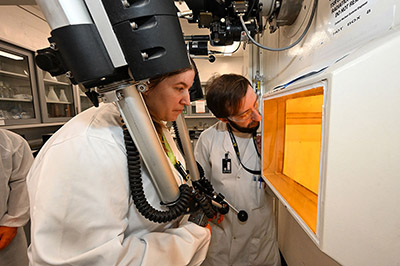
SUNY Suffolk student Arin Morton (left) simulates operating equipment in a hot cell
facility — a specialized lab and equipment needed for processing radioactive materials
— alongside mentor Michael Chimes of Brookhaven's Isotope Research & Production Department.
(Kevin Coughlin/Brookhaven National Laboratory). For a hi-res image of this photo
and other photos, visit: https://photos.app.goo.gl/fnZeHU9cnDHkG3yv8
After a semester of challenging coursework and weeks of demanding hands-on laboratory training, 11 Suffolk County Community College (SUNY Suffolk) students and recent graduates are ready to apply new skills in nuclear technology and radiochemistry beyond the classroom. They are the first cohort to complete the Nuclear Technology and Radiochemistry Technical Pathway (NTRTP), an innovative pilot workforce development program sponsored by the U.S. Department of Energy’s (DOE) Office of Science’s Office of Workforce Development for Teachers and Scientists (WDTS) and led by DOE’s Brookhaven National Laboratory and SUNY Suffolk.
The pilot track is part of a broader mission to leverage close collaboration between DOE national laboratories and regional community colleges to co-develop pathways that prepare a new regional crop of technical professionals in alignment with DOE mission critical priorities and regional energy industry workforce needs. Brookhaven is one of five National Laboratories that the DOE Office of Science’s WDTS invited to join the initiative.
“Our goal was urgent: modernize the technical workforce across the Department of Energy’s mission-critical frontiers from quantum and artificial intelligence to fusion energy and nuclear technology,” said WDTS director Ping Ge.
By partnering with regional community colleges, the program taps into a motivated pool of local talent in the STEM ecosystem, Ge and others noted.
“Our partnership with Brookhaven National Laboratory reflects Suffolk County Community College's commitment to preparing students for the careers of tomorrow while meeting the workforce needs of our region," said Edward T. Bonahue, president of Suffolk County Community College. "By combining classroom instruction with hands-on experiences at one of the nation's premier research laboratories, we're creating meaningful pathways to high-demand careers and helping strengthen Long Island's innovation economy."
Program organizers drew on Brookhaven Lab’s expertise in nuclear technology and radiochemistry to shape the pilot.
Starting in January, the group spent 15 weeks of classroom time learning new concepts and applying them to laboratory exercises, radiological control best practices, and techniques to identify and quantify radioisotopes — radioactive forms of chemical elements. Then, they spent three weeks at Brookhaven immersed in labs that prepared them to safely handle materials, follow procedures, analyze data, and practice with real instrumentation.
Students met cyclotron engineers, radiological control staff, isotope researchers, and members of the Radiological Assistance Program. They toured facilities such as the Brookhaven Linac Isotope Producer, one of just a few facilities in the United States where medical isotopes used to diagnose and treat diseases are produced; the Tandem Van de Graaf, an accelerator that, in part, supports studies on the effects of cosmic radiation at the NASA Space Radiation Laboratory; and the Waste Management Facility, where trained staff safely manage radioactive waste. Together, those experiences provided a broad introduction to the many career paths supported by nuclear science and technology.
Along the way, they learned laboratory protocols, radiation safety practices, technical concepts, research methods, professional standards, and even how to give effective presentations, said Sharon Pepenella, senior research programs representative with Brookhaven’s Office of Workforce Development & Science Education.
“Experiential learning allows students to move beyond theory and into application,” Pepenella said. “It builds confidence, it develops technical fluency. It helps students understand not only how science is conducted but also how they fit within the scientific community. When students have the opportunity to engage with real instrumentation, real facilities, and real scientific challenges, they begin to see themselves differently.”
For Jack Ferguson, a SUNY Suffolk graduate who is headed to Pennsylvania State University in the fall, the experience solidified his interest in nuclear engineering and research.
“I feel like I got a head start in the field by attending this program,” Ferguson said. “It definitely cemented that this is something I want to do for the rest of my life.”
The program closed on June 12 with student presentations on techniques or concepts they learned and how they can apply them to different career paths and fieldwork, including environmental monitoring, medical treatment, national nuclear security, engineering and facility operations.
Students shared a new appreciation for rigorous safety protocols, pride in meeting lab expectations, favorite lab activities and tour stops, and how the lab experience opened their eyes to the many fields and professions where nuclear technology and radiochemistry play an important role.
Christian Leuenroth, a SUNY Suffolk graduate who will soon attend the University at Buffalo to study aerospace engineering, learned how often nuclear science intersects with his own field. He especially enjoyed learning about cosmic radiation and shielding — the ability of materials to protect people and equipment from radiation exposure.
“The lab experience has honestly been amazing,” Leuenroth said. “This is definitely the most demanding chemistry lab experience I’ve ever had and I have enjoyed that.”
Program supporters shared words of encouragement for the students as they move on in their education and careers.
SUNY Suffolk professor of engineering Wesley Francillon asked his students if they ever felt out of their comfort zone throughout the program.
"Fantastic," he said as they nodded. He encouraged them to embrace challenges and recognize their own potential. "I hope you learned to take those experiences and run with them," he said. "Stay passionate, keep pushing."
Brookhaven Lab interim Deputy Director for Science & Technology for Science & Technology Martin Schoonen said, “I hope this experience gives you the sense of the kinds of contributions you can make to society.”
Program organizers from Brookhaven Lab thanked WDTS, SUNY Suffolk partners, Lab leadership and mentors across departments for their support in developing the pilot. It took a village to make sure this program ran, noted WDSE manager Aleida Perez.
In turn, program leads thanked the students for participating in a rewarding, new program.
“You embraced new experiences, overcame obstacles and challenges, and grew into employable technical professionals,” Nastaran Ghazi, program manager for the WDTS Community College Internship program, told the students. “You’ve shown that you truly belong in this space. You are pioneers of this model and can inspire and open the door for programs across the DOE complex.”
About Brookhaven National Laboratory
Brookhaven National Laboratory is supported by the Office of Science of the U.S. Department of Energy. The Office of Science is the single largest supporter of basic research in the physical sciences in the United States and is working to address some of the most pressing challenges of our time. For more information, visit science.energy.gov. Follow @BrookhavenLab on social media. Find us on Instagram, LinkedIn, X, and Facebook.
Please contact Kelly Lazzaro, Senior Public Affairs Representative, Media & Communications Office, for media questions at klazzaro@bnl.gov or (631) 344-8825.
About Suffolk County Community College
Suffolk County Community College is the largest, most comprehensive community college in the State University of New York (SUNY) system, enrolling more than 26,000 students in over 100 degree and certificate programs. With approximately145,000 alumni, Suffolk County Community College is dedicated to meeting the demands of regional employers. The college has built an extensive track record of successfully training and educating its students through pathways from high school to college and into careers.
Last revised: 8/10/2026. For comments on this webpage, contact: The Director of College Relations.
